Quest for intellectual property leads to improvements for consumers
In the consumer lawn and garden industry, many packaging and applicator systems are developed by large packaging suppliers and sold as generic or mildly customized solutions to product manufacturers. Much of the intellectual property for hose-end ready-to-spray (RTS) applicators is controlled by a few suppliers. This gave companies like ScottsMiracle-Gro limited sourcing options and increasingly exposed them to rising packaging costs and reduced supply chain flexibility.
ScottsMiracle-Gro initiated a project to develop a new proprietary Ready to Spray (RTS) applicator platform that would allow them to own the intellectual property and source the product competitively from multiple manufacturers to ensure competitive pricing. In addition to this strategic objective, the team sought to improve the consumer experience, ergonomics, and usability of hose-end applicators. To achieve this, the ScottsMiracle-Gro team engaged with their long-term development partner, Design Central, to develop a new RTS platform.
Client
- ScottsMiracle-Gro
Industry
- Consumer
Capabilities
- Product Design
- User Experience
- Engineering
- Prototyping
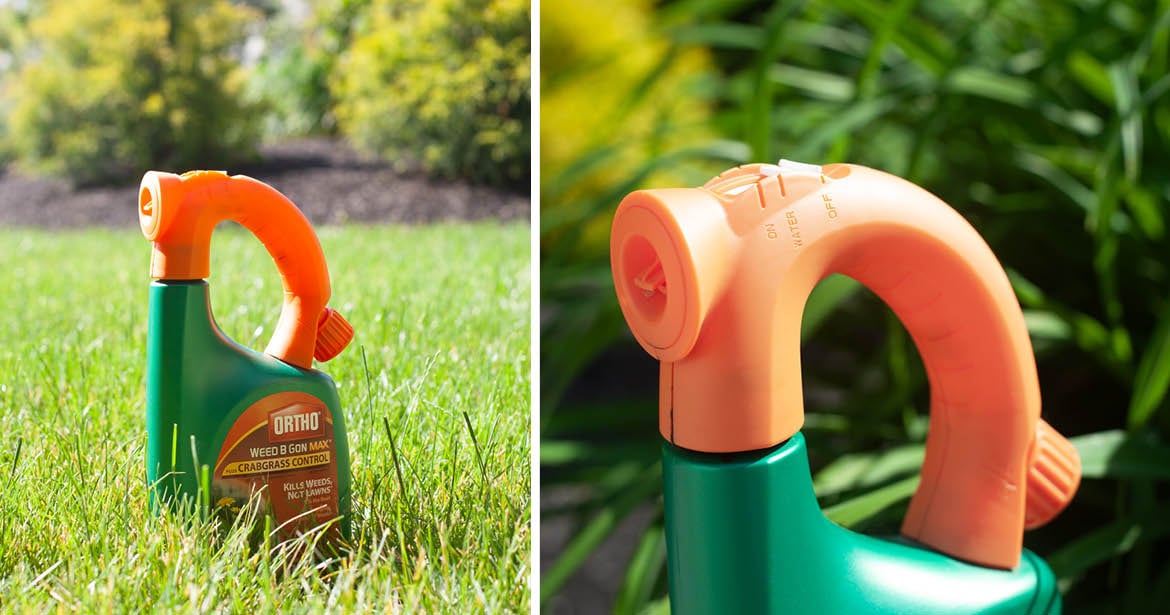
Objective: Develop a proprietary ready-to-spray (RTS) hose-end applicator platform that ScottsMiracle-Gro could own and control

Making Meaningful Improvements
Most hose-end sprayers at the time relied on a rotary valve architecture that allowed only two positions: Off and On (water + product). These systems were covered by existing patents and offered limited user control. In addition, many designs were ergonomically basic and could be difficult to operate comfortably when connected to a garden hose.
The team recognized that by developing a completely different linear valve architecture, Scotts could both avoid existing patents and introduce meaningful improvements to the user experience.
Design Central developed a new linear valve mechanism that became the core intellectual property of the ready-to-spray platform. Instead of a rotary valve, the system uses a sliding linear valve actuated by a top-mounted, pivoting, thumb-actuated control, allowing simple one-handed operation. It also provided increased control by providing three operating positions; off, water only, and water + product.
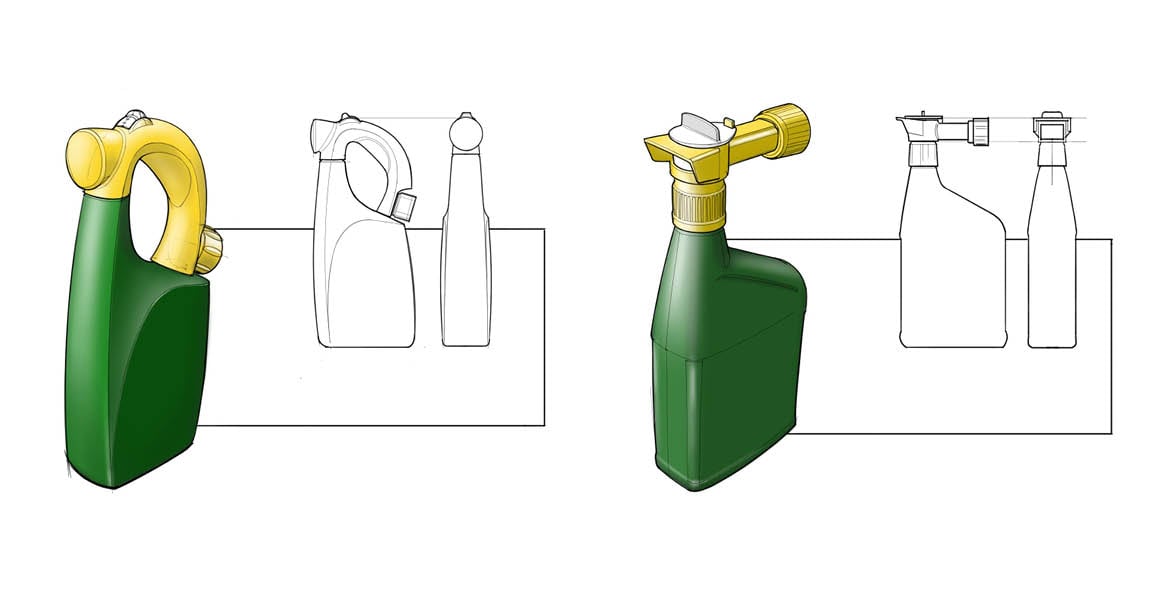
Exploring the fullest potential of a new design
The final bottle design also improved the experience for the consumer, introducing a highly aesthetic and ergonomic handle design that improved comfort and control, and a stronger applicator-to-bottle connection. The angled hose connection reduced leakage and torque on the user’s hand, thereby improving spray control. An integrated venturi mixing system accurately diluted the concentrated product, and incorporated backflow/anti-siphon protection prevented contamination of the water supply. In addition to these end user improvements, the new design also included a snap-on bottle interface to speed manufacturing filling and capping.
The result was a rugged design optimized for high-volume manufacturing and long-term durability.

A satisfying solution
This new applicator design gave ScottsMiracle-Gro the proprietary technology they had been seeking, with multiple patents produced including design, utility, and international filings. They were able to source the product competitively from multiple manufacturers, helping their bottom line.
Improved consumer ergonomics and usability solved customer pain points at the same time, leading to Scotts adopting the new design across multiple RTS lines. While ScottsMiracle-Gro has since implemented internal revisions focused on cost optimization, the core functional architecture developed continues to form the basis of the system currently in market. More than a decade after launch, the applicator mechanical platform remains in use across ScottsMiracle-Gro products, demonstrating the durability and long-term value of the original design architecture.